AI · Cybersecurity · Machine Learning
PhishGuard
NextGen
An AI-powered phishing detection system that analyzes website URLs and HTML content using transformer-based machine learning to identify phishing threats and provide explainable security alerts.
URL + HTML Model
92.73%
Accuracy
URL-only Model
94.05%
Accuracy
URL-only Recall
97.90%
Phishing detection recall
System Recall
77.00%
End-to-end evaluation
Project Interface
See PhishGuard
in action.
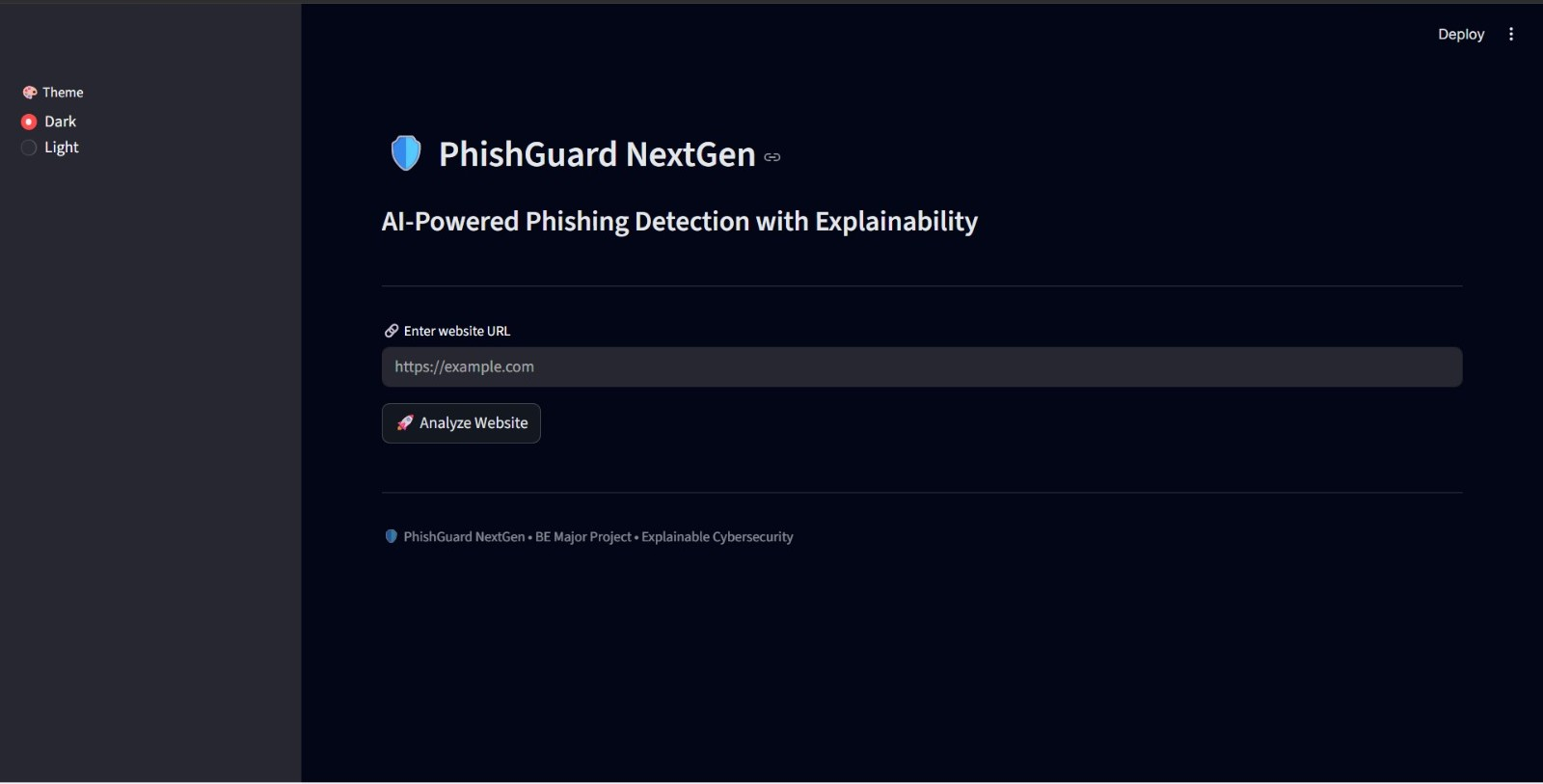
The system provides a web interface for analyzing URLs and displaying phishing probability, verdicts, explanations and security recommendations.
PhishGuard NextGen Interface
URL analysis and phishing detection
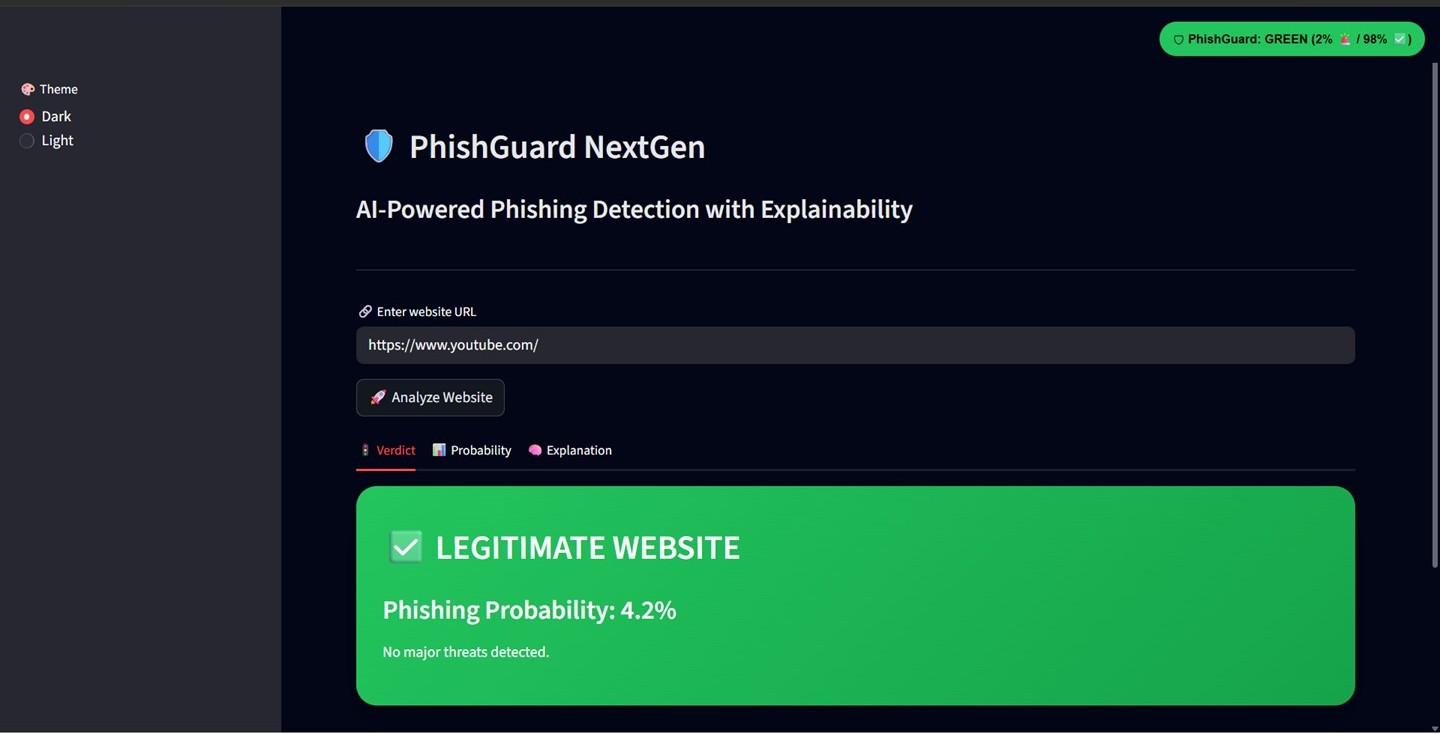
Legitimate Website Detection
Example of a low-risk website classification
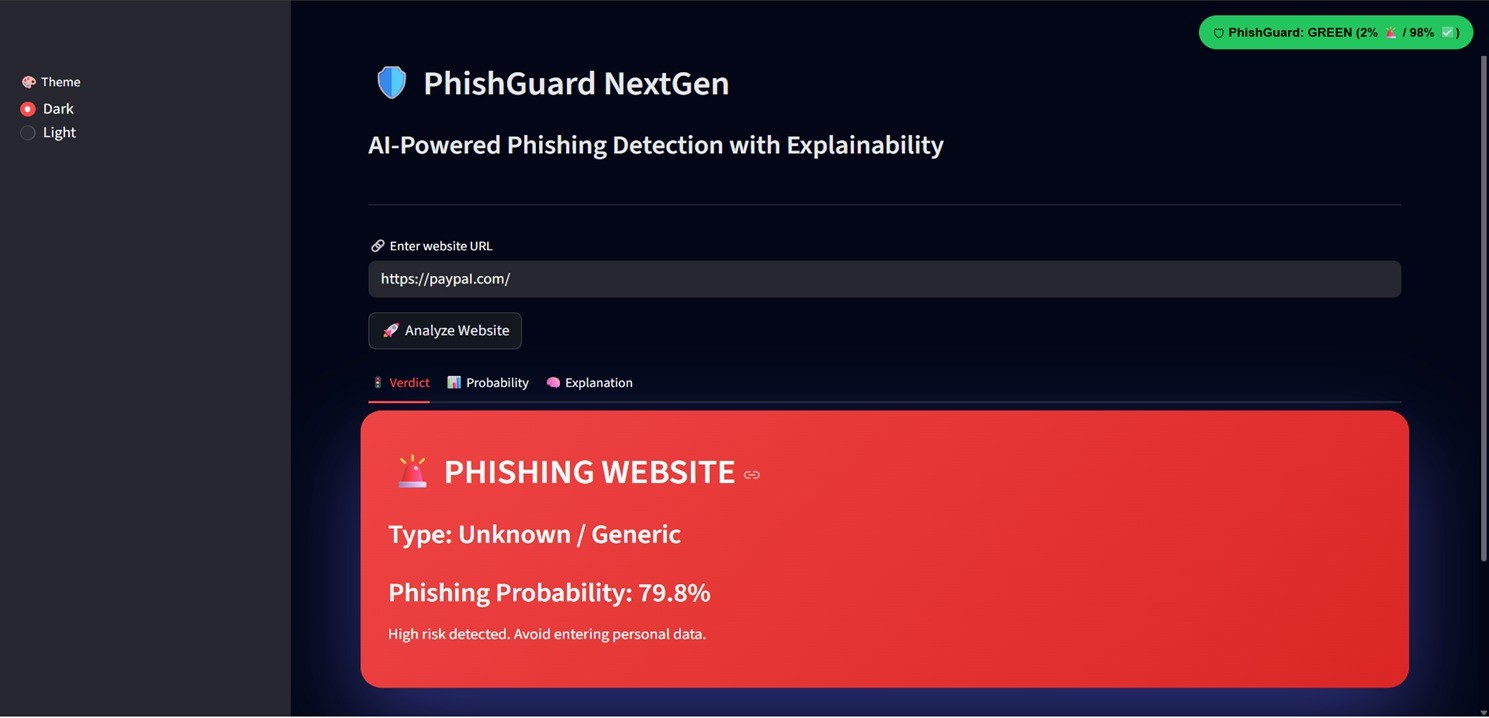
Phishing Website Detection
High-risk classification with phishing probability
Browser Protection
PhishGuard browser extension providing real-time website status

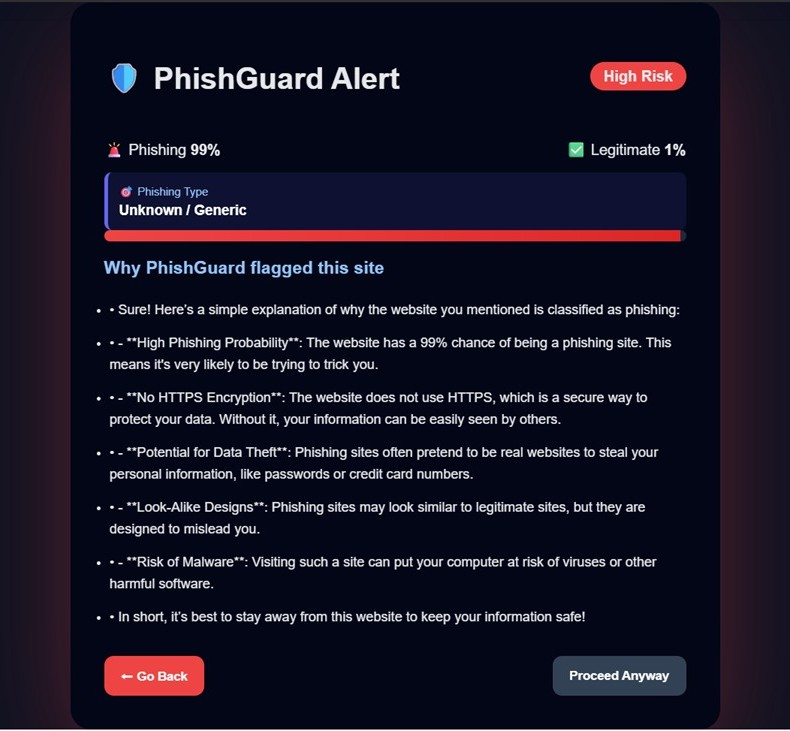
Phishing Alert & Explainability
Security warning with reasons behind the classification
Project Overview
Detecting phishing
with AI.
Phishing websites are designed to imitate legitimate websites and trick users into revealing sensitive information.
PhishGuard NextGen was developed as a BE Major Project to provide an AI-powered approach to detecting potentially malicious websites.
The system combines URL analysis, HTML analysis, transformer models and explainable outputs to provide users with a clear security verdict.
System Architecture
From URL input
to security verdict.
01
URL Input
User enters the website URL that needs to be analyzed.
02
HTML Analysis
The system can retrieve and analyze website HTML content.
03
AI Classification
MobileBERT-based models analyze the available website information.
04
Explainable Verdict
The system presents phishing probability, risk level and explanations.
Core Features
More than just
a phishing classifier.
URL Analysis
Analyzes website URLs to identify patterns associated with phishing websites.
HTML Analysis
Uses website HTML content as an additional signal for phishing detection.
MobileBERT
Uses transformer-based MobileBERT models for phishing classification.
Explainable AI
Provides understandable reasons behind high-risk classifications.
Risk Scoring
Communicates phishing probability and overall website risk.
Browser Protection
Chrome extension integration helps provide protection while browsing.
Streamlit Interface
Interactive interface for entering URLs and reviewing predictions.
FastAPI Backend
Backend API architecture supports the application's prediction workflow.
URL-only Fallback
A URL-only model provides an alternative when HTML-based analysis is unavailable.
Model Evaluation
Comparing the
detection approaches.
| Evaluation | Accuracy | Precision | Recall | F1 |
|---|---|---|---|---|
| URL + HTML MobileBERT | 92.73% | 94.35% | 91.00% | 92.64% |
| URL-only Model | 94.05% | 90.90% | 97.90% | 94.27% |
| System-level Evaluation | 70.65% | 68.32% | 77.00% | 72.40% |
Explainable AI
Don't just say
“phishing”.
PhishGuard goes beyond a binary prediction by presenting understandable explanations for why a website may be considered dangerous.
Project Impact
Combining AI with
practical cybersecurity.
Threat Detection
Machine learning provides an automated approach for identifying potentially malicious websites.
User Awareness
Explainable alerts help users understand why a website may be unsafe.
Real-Time Protection
The browser extension concept brings phishing detection closer to the user's browsing experience.
Learning Outcomes
What this project
taught me.
01
Transformer-based NLP
02
Cybersecurity analysis
03
Machine learning evaluation
04
API development
05
Streamlit application development
06
Explainable AI
07
Browser extension integration
08
End-to-end project architecture
Project Takeaway
AI-powered security
with explainable results.
PhishGuard NextGen demonstrates how machine learning, NLP, cybersecurity and application development can be combined to create a practical phishing detection solution.